New Location

You can find all the old content and new stuff too at worldplatterblog.wordpress.com
Showing posts with label dip. Show all posts

Wednesday, March 18, 2015

Hummus

Dried chickpeas. Canned chickpeas are the express lane to hummus, however.
Hummus, that simple Middle Eastern pureé of chickpeas, tahini, and lemon juice has taken the country by storm. Hummus is the next salsa, available in supermarkets and convenience stores everywhere. You can even pick up a snack pack at the airport. In my recipe, a generous dose of olive oil helps to emulsify the ingredients so it's smooth and creamy. Adds some delicious flavor too. Some recipes use more tahini then this one. Tahini is roasted sesame seed paste. Think peanut butter made with sesame seeds. Unlike peanuts, sesame seeds have a bitter edge, so I go light on the tahini. If you add too much, the hummus is bitter and a little chalky.

You can make your own hummus easily if you have a food processor. Without it, it's not easy to get a smooth pureé. There are lots of commercial hummuses out there now. Some are good and some are weird and well, not so good. My favorite brand is Sabra. The original and the red pepper are our favorites. My daughter, who once upon a time described hummus as disgusting, is now a huge fan.

Hummus is a great way to get more beans into your diet. Chickpeas (also known as garbanzo beans) are one of my favorite beans. They are full of protein, fiber, and complex carbohydrates. They soak up flavors and are important is a wide variety of cuisines: Italian, Indian, Middle Eastern. In Italy, they are called ceci and they combine deliciously with pasta, like in this recipe for pasta with chickpeas, spinach, and sausage.

This recipe is super easy because I used canned chickpeas. If you have some time or a pressure cooker, you can cook them yourself. You'll need 1 ¾ - 2 cups cooked chickpeas. You can use the juice from ½ a lemon up to 1 lemon's worth. If you use a whole lemon, it will be fairly tart and lemony. A whole lemon yields about 3 Tablespoons of juice.

Hummus
(makes about 2 cups)

1 15 oz. can chickpeas, drained but with liquid reserved
juice of ½ - 1 lemon
5 cloves garlic, peeled and coarsely chopped
3 Tablespoons tahini
½ teaspoon black pepper
½ - 1 teaspoon salt
4 Tablespoons olive oil plus more for garnish

Add the chickpeas, ½ of the reserved liquid, lemon juice, garlic, and tahini. Process until the chickpeas are a thick pureé. If it's lumpy, add more of the can liquid until it starts to smooth out. Add ½ teaspoon salt, black pepper, and the olive oil. Process until it's smooth and creamy. Check for salt; add more if necessary. Gets better if allowed to mellow in the fridge for a few hours, though it's best eaten near room temperature. To serve, drizzle with more olive oil.

Wednesday, June 25, 2014

Romesco Sauce


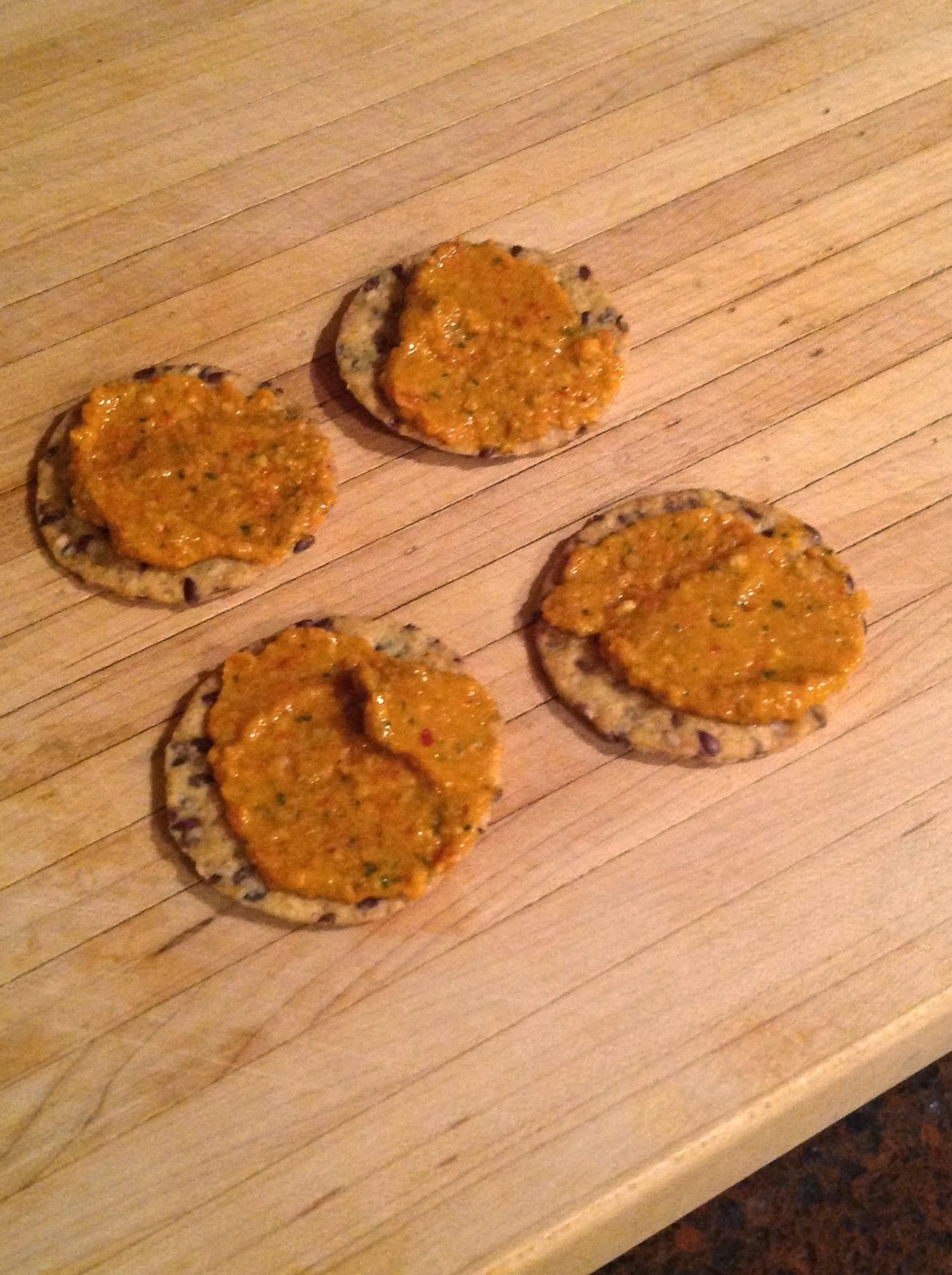
Romesco sauce, a pungent combination of roasted red pepper, garlic, nuts, and chile flakes, is a delicious accompaniment to grilled meats or poultry, fish, or even as a dip for veggies or crackers. I love most anything with roasted red peppers and this sauce is no exception. It's an addictive combination.

The bread, which is acts as a thickener, is usually fried in olive oil. This recipe, from Martha Rose Shulman, skips the frying and uses toasted bread. It makes the recipe quicker. I wouldn't say it makes the sauce light- this is a rich sauce even with toasted bread!

I like Aleppo chiles in this recipe. They are sweet-hot and a little fruity. In Boulder, you can find Aleppo chile flakes at the Savory Spice Shop, my favorite herb and spice purveyors in town. And if you don't have a Savory Spice Shop in your town, they take on-line orders

Romesco Sauce
(makes about 2 cups)

1 large roasted red pepper, cored and skin removed, roughly chopped
¾ pound ripe tomatoes (3 to 4 whole tomatoes)
2 large cloves garlic, peeled
¼ cup whole almonds, toasted
2 oz. crusty white bread, lightly toasted
1-2 teaspoons medium-hot chile flakes, such as Aleppo chiles
1 Tablespoon chopped fresh parsley
1 teaspoon sweet paprika
1 ½ teaspoons salt
½ teaspoon freshly ground pepper
2 Tablespoons sherry vinegar
¼ cup extra virgin olive oil

Place the whole tomatoes on a metal pan and place under the broiler. Broil until it develops some char. Turn over and repeat on the other side. Remove from the oven and let cool slightly. Remove the the skin, and set aside the tomatoes.

With the food processor running, throw in the garlic to mince. Stop the processor and scrape garlic off the sides. Add in the almonds, bread, and chile flakes, and process to a paste. Scrape down the sides again, and add the red pepper, tomatoes, parsley, paprika, salt, and black pepper. Process until smooth. Scrape down sides. With processor running, add the vinegar and then the olive oil in a slow stream. Process until smooth and well-combined. Scrape the sides and taste. Add more salt if needed.

Best if served at room temperature. The garlic flavor builds if it is kept in the refrigerator. Can be refrigerated for up to 5 days. Great as a spread on bread or crackers or as a sauce on fish, chicken, lamb, or vegetables.

From Mediterranean Harvest by Martha Rose Shulman, Rodale, Inc., 2007.

Sunday, January 8, 2012

Fun with Eggplant

Eggplant was on sale this week. I wanted to make some baba ghanoush but I bought enough to make more than that. So, here are 2 recipes that use eggplant. In fact, they both start with eggplant broiled whole but after that, they go in totally different directions. There are no pictures of the dishes because neither of them looks all that interesting. But, they taste so good, each in their own way.

Baba ghanoush is a Middle Eastern eggplant dip enhanced with tahini and lemon juice. It retains the delicious smokiness that comes from getting the eggplant skin well-charred.

The other recipe is Indian, using a plethora of fragrant spices to transform the eggplant into something special. It's called Creamed Eggplant but the cream isn't that key to the dish. You could leave it out and it would still be awesome. The original recipe called for vegetable oil. I used butter instead and I do think it adds a depth of flavor. Use vegetable oil if you prefer. There is enough flavor here even if you use a neutral oil.

Both recipes came from Madhur Jaffrey's World of the East Vegetarian Cooking. I have added additional instructions on broiling the eggplants. She says to rinse them after peeling but I feel that is not necessary. Just be careful about removing all the skin because it would add a lot of bitterness, seeing as it's burned totally by the time it's done. It does take a while to cook the eggplant but it's worth it. The long broiling develops the smoky flavor that enhances both recipes.

Followers