New Location

You can find all the old content and new stuff too at worldplatterblog.wordpress.com

Friday, November 15, 2013

Chickpea Pancake


I made this for a neighbor's home-brew party. It seemed like an excellent beer food. And it was, based on how quickly it disappeared! The recipe is from Mark Bittman's How to Cook Everything Vegetarian, though I tweaked it a little. Garbanzo bean (or chickpea) flour is easier to find in these gluten-free times. I found it in the natural food aisle of my local King Soopers among all the other more esoteric flours brought to you by Bob's Red Mill. It's a brand I love not for the gluten-free stuff, since I eat gluten with great relish, but because they carry lots of interesting things, like buckwheat flour, multigrain cereals, and polenta.

I used a 12" cast-iron griddle - the one in the photo - but Bittman says you can use a 12" skillet or pizza pan with a raised edge because the batter is quite thin. Make sure it's well-seasoned or non-stick to avoid sticking.

Chickpea Pancake
(serves 4-6 as a side dish, 12 as an nibble with beer)

1 cup chickpea flour
1 ½ cups warm water
1 teaspoon salt
1 teaspoon black pepper
4 Tablespoons tasty olive oil
½ a small onion, thinly sliced
½ to 1 Tablespoons chopped fresh rosemary

Place water in a medium bowl. Sift in chickpea flour (it tends to be lumpy) and whisk. Add salt, black pepper, and 2 Tablespoons olive oil. Cover with a towel and let sit for 30 minutes or up to 12 hours.

Preheat oven to 450°F. Put 2 Tablespoons olive oil in the skillet and brush or swirl it around to cover entire bottom. Add onions and rosemary to batter and mix. Pour into the skillet. Bake for 20 minutes until set. You can bake it another 5-10 minutes to brown it or you can stick it under the broiler to brown, if you skillet can take broiler temps.


Friday, November 8, 2013

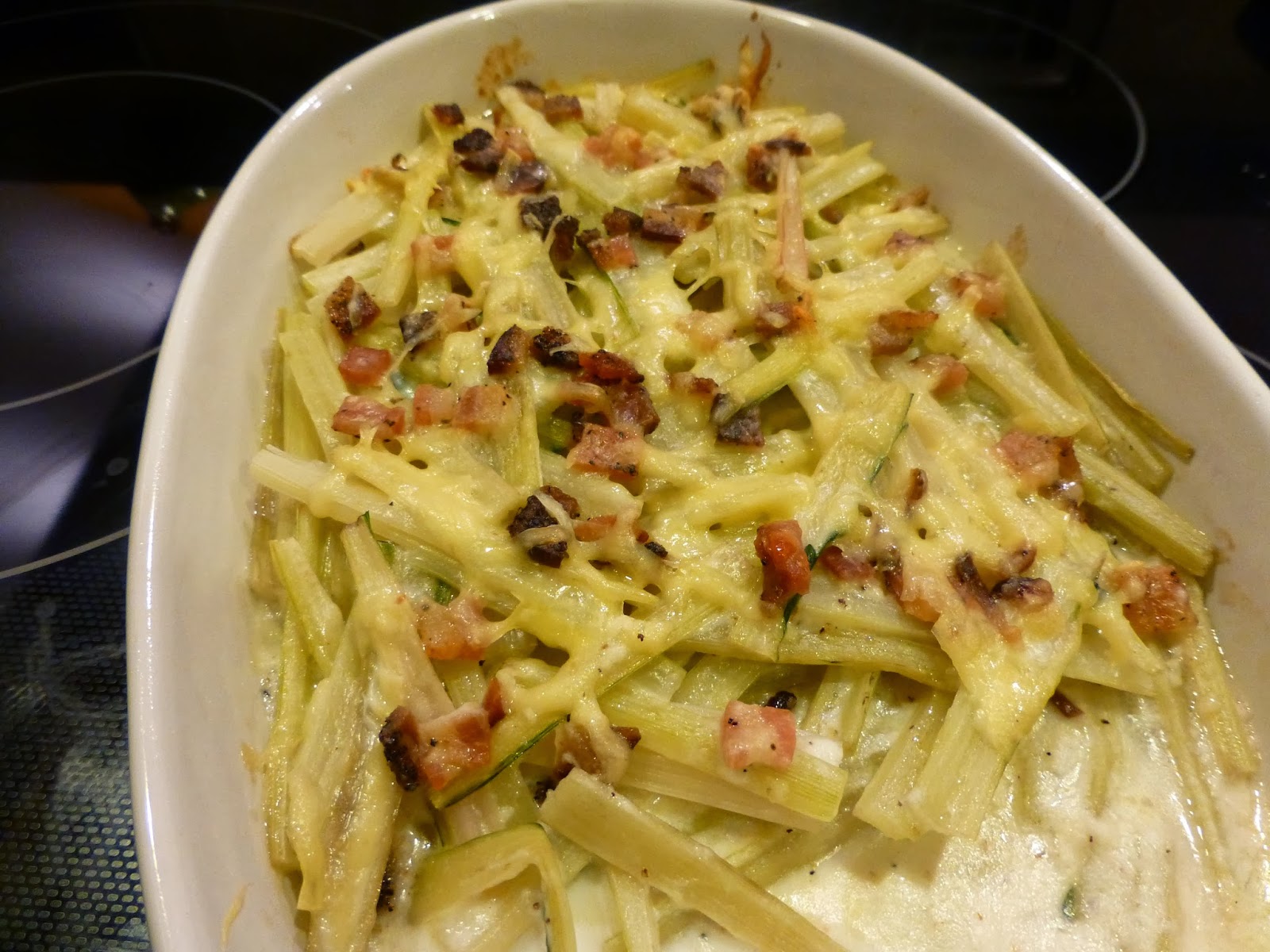
Chard Stem Gratin


We're coming up on the end of chard season here in Colorado, at least in my sun-deprived garden. I picked it all this week because a) it's not going to grow anymore (that lack of direct sun thing), and b) it's getting below 20°F at night, which is cold enough to damage the leaves.

What does one do with all that chard? I picked about 1 pound of leaves and 2 pounds of stems. I usually separate the leaves from the big stems because the stems take much longer to cook. I will blanch and freeze a bunch (my husband and I can only eat so much chard). The rest went into this gratin.

A gratin is a baked dish, usually enriched with milk or cream, though you don't have to make them creamy and cheesy. I posted a non-milk based potato gratin; it contained only a small amount of cheese. The cooking liquid was broth. It was still quite tasty. This gratin is richer - but chard is not filling at all, so you want a richer sauce.

When shopping for chard, assuming you don't have a garden to provide you with a big bunch, buy about 2 ½ pounds. Chard yields 50% stem, and 50% leaves, approximately. Look for bunches with bigger stems. My garden chard (variety Burpee's Fordhook Giant) grows particularly large fleshly stems.

You can use bacon fat or butter for the sauce. If you use the bacon for garnish, dice it raw and cook it in a saucepan. Remove the bacon bits and add more bacon fat or butter to measure about 2 Tablespoons to make the sauce.

Swiss Chard Stem Gratin
(serves 6-8)

1 ¼ pound Swiss Chard stems, cut into 4" long x ½" wide sticks
non-stick cooking spray or butter
2 Tablespoons bacon fat (or use butter)
1 ½ Tablespoons flour
1 ½ cup milk (2% or whole)
1 pinch nutmeg
large pinch of black pepper
salt (not much if using bacon fat)
¾ cup grated Swiss cheese, like Jarlsberg or Gruyere
2-3 sliced cooked bacon, diced (optional)

Preheat oven to 350°F. Grease a large gratin pan with cooking spray or butter. Set aside.

Bring a large pot of salted water to boil. Cook chard in boiling water for 5 minutes. Drain and chill with cold tap water. Set aside to drain while you make the Bechamel sauce.

Heat bacon fat in a medium saucepan. Stir in flour and cook for a couple of minutes. Slowly add milk and whisk to prevent lumps. Keep whisking until sauce thickens slightly, about 5 minutes. Add nutmeg and black pepper. Taste for salt (bacon fat will add a bit of salt); add more if needed. Remove from heat and whisk in ½ cup Swiss cheese until it has melted into the sauce.

To assemble gratin, spread chard stems in pan in an even layer. Sprinkle on diced bacon, if using. Pour sauce evenly over chard. Sprinkle on remaining ¼ cup cheese. Bake for 30 minutes until bubbly around the edges.

Adapted from Vegetables by James Peterson, William Morrow and Company, 1998.

Thursday, November 7, 2013

Mark Bittman's Memorial to Marcella Hazan


If you haven't yet, check out Mark Bittman's memorial to Marcella Hazan in The New York Times Magazine. I posted Marcella's recipe for pesto soon after her death in late September. I never met the woman, so have no memories to share besides my enjoyment of her cookbooks. But Bittman did get to cook with her and he shares some lovely memories, enough to give you the sense of this methodical and opinionated Italian cook who taught many of us about real Italian cooking. He went to Florida and cooked with her only weeks before her death.  What a lucky guy.

Tuesday, October 29, 2013

Chunk Pickles


The verdict is in (on the pickles I made back in August). These are delicious. Sweet and spicy. Nice tang and good crunch. One reason I like this recipe is you can use any size of cucumbers, not just pickling cukes. My garden isn't big enough to produce enough pickling cukes at once (I hope to change that next year when I take out a tree to get more sunlight on my garden). The original recipe calls for alum. Alum is not added to pickles anymore, so I've left it out. I also up'ed the amount of syrup. The original recipe didn't make enough to fill all the jars. I left the proportions the same.


Chunk Pickles
(makes about 5 pints)

Tuesday, October 15, 2013

Chocolate Zucchini Cake


Zucchini bread, the classic way to use up too much zucchini from the garden. Or your neighbor's garden. But, my zucchini plant was chewed up by a squirrel, then yanked up by a deer who didn't even have the decency to eat the thing. So, definitely a zucchini shortage in my house this summer. A friend of a friend bestowed an overgrown zucchini so I was able to test out a new chocolate zucchini "cake." I have a recipe that is a bit out of control - too much sugar, too much fat, and too much cake unless you are bringing it to a large gathering. But, I like the concept.

The first time I baked this, I used a loaf pan (see picture above). But, it's so moist and soft that it really works better in a square cake pan. It also bakes up faster because it has spread out more.

I used Dutch cocoa the first time, which results in a darker color and a richer chocolate flavor. The second time, I used natural cocoa (most commonly seen as Hershey's cocoa). The color is lighter as is the flavor. Feel free to try it either way. Both are good, as my husband and friends will attest.

If you end up using a baseball bat zucchini, don't grate up the center part with the seeds. Just use the fleshy outside layer.

If you are baking this cake at sea level (I live at 5400 ft above sea level), increase the baking powder to 1 teaspoon, which is my best guess on the correct amount for you flat-landers.

Chocolate Zucchini Cake
(serves 9-12)

Tuesday, October 1, 2013

Marcella Hazan: 1924-2013


Marcella Hazan passed away in Florida this week. You can read her obit in the New York Times. She did for Italian food what Julia Child did for French food: she brought the real deal to cooks in the US. Italian food in the US was largely refracted through a Southern Italian lens so everyone thought that Sicilian food was all there was to Italian food before Marcella came along. Like so many cuisines, Italian cuisine is regional, varying greatly from the lagoons of Venice to the rich valleys of Emilia-Romagna to the rocky slopes of Sardinia.

I have both The Classic Italian Cook Book and More Classic Italian Cooking. The recipes are simple, yet detailed, and delicious. Mrs. Hazan lived in Emilia-Romagna as a child but her books are a trip through all the regions of Italy. She has a recipe for Meat Sauce, Bolognese Style, from her home region, as well as five recipes for Polenta which she says was the "staff of life" in much of Lombardy and all of Venetia (the northeast corner of Italy), and Hothouse Lamb, Roman Style from Rome, naturally. Many Italian regional books have followed - I have a lot of them - but Mrs. Hazan was the first. And she'll always be the greatest for me.

Later this week, really cold weather is moving in. It's likely that Boulder will experience the first hard frost of the year. (We already had a light one last Friday night.) That means I must pick all the basil and make pesto. That's about as Italian as you can get, isn't it? Today, everyone knows pesto and it is well-loved in the US. But, back in 1973 when the first printing of The Classic Italian Cook Book came out, very few Americans had ever eaten or heard of pesto. It's from a rather obscure region of Italy: Liguria. Well, not obscure anymore. The Cinque Terre, that string of five marvelous towns clinging to the steep hillsides, is in Liguria. There are lots of riffs on pesto these days: different herbs, different nuts, different seasonings. Marcella Hazan's recipe is a departure too, as she explains in the introduction: "The old traditional recipes do not mention pine nuts or butter. But modern pesto invariably includes them, and so does this recipe." I ate pesto in a traditional restaurant in the Cinque Terre. It did include pine nuts, but definitely not butter. And no black pepper - they were particularly adamant about no black pepper. Mrs. Hazan does not use black pepper either.

The recipe is written just as it is in the book so you can see how thorough she was describing how to make something as simple as pesto.

My notes on the recipe: I don't need that much salt in my pesto. Half a teaspoon is enough for me. Your mileage may vary.

Blender Pesto
(Enough for about 6 servings of pasta)

2 cups fresh basil leaves (see note below)
½ cup olive oil
2 Tablespoons pine nuts
2 cloves garlic, lightly crushed with a heavy knife handle and peeled
1 teaspoon salt
½ cup freshly grated Parmesan cheese
2 Tablespoons fresh grated Romano pecorino  cheese
3 Tablespoons butter, softened to room temperature

Put the basil, olive oil, pine nuts, garlic cloves, and salt in the blender and mix at high speed. Stop from time to time and scrape the ingredients down toward the bottom of the blender cup with a rubber spatula.

When the ingredients are evenly blended, pour into a bowl and beat in the two grated cheeses by hand. (This is not much work, and it results in more interesting texture and better flavor than you get when you mix the in the cheese in the blender.) When the cheese is evenly incorporated into the other ingredients, beat in the softened butter.

Before spooning the pesto over pasta, add it to a tablespoons of the hot water in which the pasta boiled.

Note: The quantity of basil in most recipes is given in terms of whole leaves. American basil, however, varies greatly in leaf sizes. There are small, medium, and very large leaves, and they all pack differently in the measuring cup. For the sake of accurate measurement, I suggest that you tear all but the tiniest leaves into two of more small pieces. Be gentle, so as not to crush the basil. This would discolor it and waste the first, fresh droplets of juice.

Thursday, September 26, 2013

Adventures with Bison Liver: Mushroom and Liver Pate


A dear friend of mine has an unusual perk at her place of employment: access to bison meat. Because I have room in my freezer, I have a bit of it stashed in my chest freezer, including a heart and a tongue. The liver was in there too, but I saw a recipe for a wild mushroom-liver paté and I had to break into the liver. I had picked some wild mushrooms (don't worry - you don't need to pick your own wild mushrooms to make this) which would be perfect for mushroom-liver paté. I've never used bison liver but how different could it be from beef liver? Actually, it's even better than beef or calves liver,  mild and sweet. Now, I don't expect you to find a bison liver either. This recipe will work with any type of liver, including chicken livers. The mushrooms mellow the liver-y flavor. It's rich and delicious. The recipe makes quite a bit, so it's best made for a party. Unless you plan on eating it on everything. I'll be posting a recipe I created to use up some of this paté soon.

Mushroom and Liver Paté
(makes about 2 cups)

Followers