New Location

You can find all the old content and new stuff too at worldplatterblog.wordpress.com
Showing posts with label food processor. Show all posts

Friday, April 1, 2016

Indonesian Beef with Onions


Another recipe adapted from the fantastic (and long out-of-print) The Good Cook series of cookbooks from Time-Life.

I used Thai Black Sweet Soy. Indonesian sweet soy sauce, called kecap manis, is also a sweet soy. I won't say they are interchangeable, but Thai sweet soy also results in a very tasty dish. Use what you have, is my motto!

Indonesian Beef with Onions
(serves 4)

1 pound top round steak, thinly sliced

Marinade
1 large onion, cut into chunks
3 large cloves garlic
3 Tablespoons kecap manis or Thai sweet soy sauce
10 peppercorns, crushed
3 Tablespoons sweet soy
pinch of ground nutmeg

1 Tablespoon oil
1 large onion
1 14 oz. can diced tomatoes, including liquid
1 stick of cinnamon
2 whole cloves

Pulverize the onion and garlic in a food processor. Place in a bowl and mix in the remaining marinade ingredients. Add the sliced beef and toss to coat. Set in the fridge to marinate for 30 minutes to an hour. Drain the beef, reserving the marinade.

Heat the oil in a wok over medium-high heat. Cook onions until they start to wilt. Increase heat to high. Add the beef and stirfry for a couple of minutes. Add the marinade and the rest of the ingredients. Reduce heat to medium. Cook until sauce thickens, about 5 minutes. Serve over rice. Try not to eat the cloves, but if you do bite into one of them, it won't kill you.

Adapted from The Good Cook: Beef & Veal, Time-Life Books, 1978.

Photo credit: By Jdmtdktdht (Own work) [CC BY-SA 3.0 (http://creativecommons.org/licenses/by-sa/3.0)], via Wikimedia Commons


Wednesday, March 18, 2015

Hummus

Dried chickpeas. Canned chickpeas are the express lane to hummus, however.
Hummus, that simple Middle Eastern pureé of chickpeas, tahini, and lemon juice has taken the country by storm. Hummus is the next salsa, available in supermarkets and convenience stores everywhere. You can even pick up a snack pack at the airport. In my recipe, a generous dose of olive oil helps to emulsify the ingredients so it's smooth and creamy. Adds some delicious flavor too. Some recipes use more tahini then this one. Tahini is roasted sesame seed paste. Think peanut butter made with sesame seeds. Unlike peanuts, sesame seeds have a bitter edge, so I go light on the tahini. If you add too much, the hummus is bitter and a little chalky.

You can make your own hummus easily if you have a food processor. Without it, it's not easy to get a smooth pureé. There are lots of commercial hummuses out there now. Some are good and some are weird and well, not so good. My favorite brand is Sabra. The original and the red pepper are our favorites. My daughter, who once upon a time described hummus as disgusting, is now a huge fan.

Hummus is a great way to get more beans into your diet. Chickpeas (also known as garbanzo beans) are one of my favorite beans. They are full of protein, fiber, and complex carbohydrates. They soak up flavors and are important is a wide variety of cuisines: Italian, Indian, Middle Eastern. In Italy, they are called ceci and they combine deliciously with pasta, like in this recipe for pasta with chickpeas, spinach, and sausage.

This recipe is super easy because I used canned chickpeas. If you have some time or a pressure cooker, you can cook them yourself. You'll need 1 ¾ - 2 cups cooked chickpeas. You can use the juice from ½ a lemon up to 1 lemon's worth. If you use a whole lemon, it will be fairly tart and lemony. A whole lemon yields about 3 Tablespoons of juice.

Hummus
(makes about 2 cups)

1 15 oz. can chickpeas, drained but with liquid reserved
juice of ½ - 1 lemon
5 cloves garlic, peeled and coarsely chopped
3 Tablespoons tahini
½ teaspoon black pepper
½ - 1 teaspoon salt
4 Tablespoons olive oil plus more for garnish

Add the chickpeas, ½ of the reserved liquid, lemon juice, garlic, and tahini. Process until the chickpeas are a thick pureé. If it's lumpy, add more of the can liquid until it starts to smooth out. Add ½ teaspoon salt, black pepper, and the olive oil. Process until it's smooth and creamy. Check for salt; add more if necessary. Gets better if allowed to mellow in the fridge for a few hours, though it's best eaten near room temperature. To serve, drizzle with more olive oil.

Wednesday, June 25, 2014

Romesco Sauce


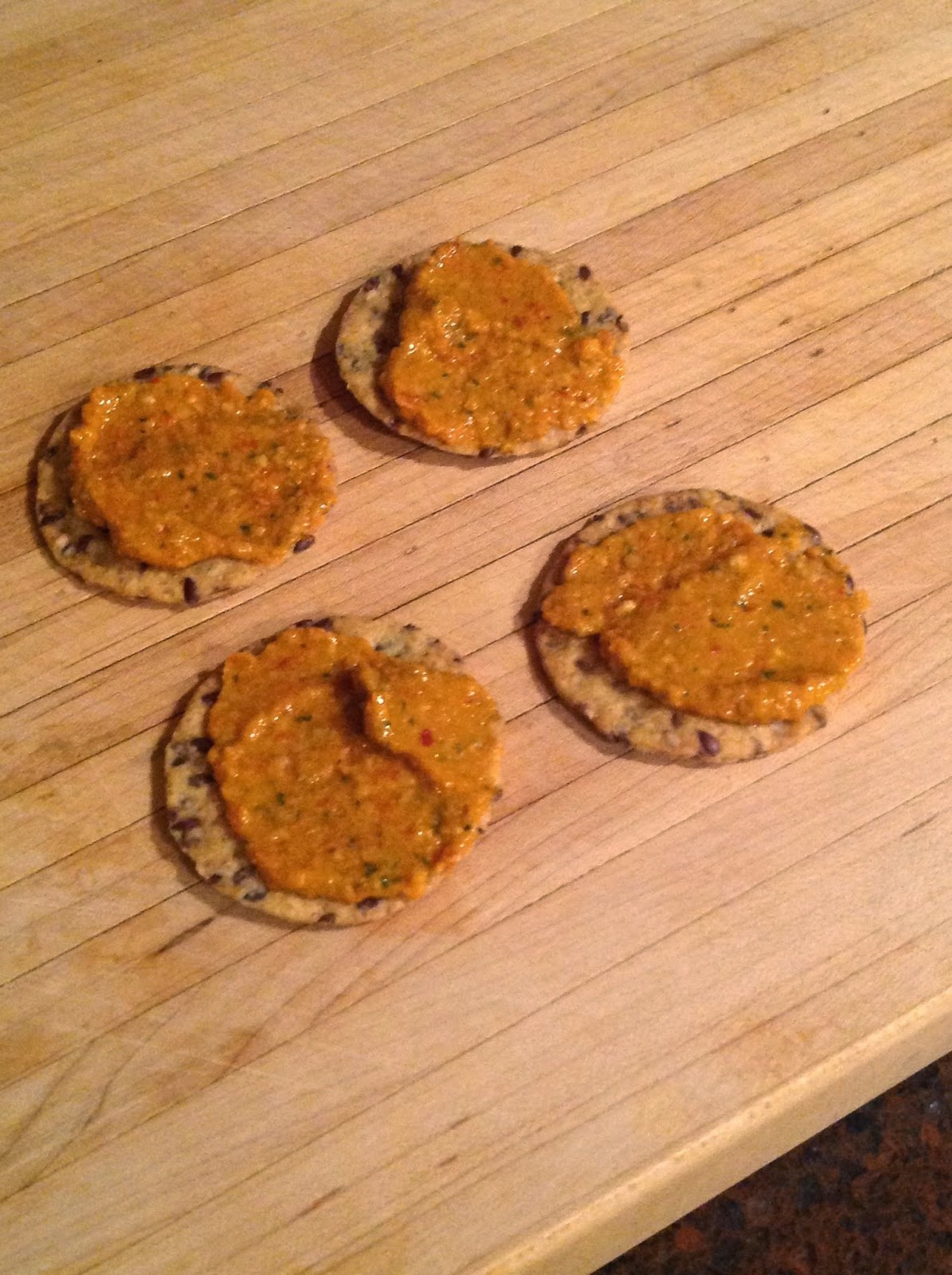
Romesco sauce, a pungent combination of roasted red pepper, garlic, nuts, and chile flakes, is a delicious accompaniment to grilled meats or poultry, fish, or even as a dip for veggies or crackers. I love most anything with roasted red peppers and this sauce is no exception. It's an addictive combination.

The bread, which is acts as a thickener, is usually fried in olive oil. This recipe, from Martha Rose Shulman, skips the frying and uses toasted bread. It makes the recipe quicker. I wouldn't say it makes the sauce light- this is a rich sauce even with toasted bread!

I like Aleppo chiles in this recipe. They are sweet-hot and a little fruity. In Boulder, you can find Aleppo chile flakes at the Savory Spice Shop, my favorite herb and spice purveyors in town. And if you don't have a Savory Spice Shop in your town, they take on-line orders

Romesco Sauce
(makes about 2 cups)

1 large roasted red pepper, cored and skin removed, roughly chopped
¾ pound ripe tomatoes (3 to 4 whole tomatoes)
2 large cloves garlic, peeled
¼ cup whole almonds, toasted
2 oz. crusty white bread, lightly toasted
1-2 teaspoons medium-hot chile flakes, such as Aleppo chiles
1 Tablespoon chopped fresh parsley
1 teaspoon sweet paprika
1 ½ teaspoons salt
½ teaspoon freshly ground pepper
2 Tablespoons sherry vinegar
¼ cup extra virgin olive oil

Place the whole tomatoes on a metal pan and place under the broiler. Broil until it develops some char. Turn over and repeat on the other side. Remove from the oven and let cool slightly. Remove the the skin, and set aside the tomatoes.

With the food processor running, throw in the garlic to mince. Stop the processor and scrape garlic off the sides. Add in the almonds, bread, and chile flakes, and process to a paste. Scrape down the sides again, and add the red pepper, tomatoes, parsley, paprika, salt, and black pepper. Process until smooth. Scrape down sides. With processor running, add the vinegar and then the olive oil in a slow stream. Process until smooth and well-combined. Scrape the sides and taste. Add more salt if needed.

Best if served at room temperature. The garlic flavor builds if it is kept in the refrigerator. Can be refrigerated for up to 5 days. Great as a spread on bread or crackers or as a sauce on fish, chicken, lamb, or vegetables.

From Mediterranean Harvest by Martha Rose Shulman, Rodale, Inc., 2007.

Thursday, September 26, 2013

Adventures with Bison Liver: Mushroom and Liver Pate


A dear friend of mine has an unusual perk at her place of employment: access to bison meat. Because I have room in my freezer, I have a bit of it stashed in my chest freezer, including a heart and a tongue. The liver was in there too, but I saw a recipe for a wild mushroom-liver paté and I had to break into the liver. I had picked some wild mushrooms (don't worry - you don't need to pick your own wild mushrooms to make this) which would be perfect for mushroom-liver paté. I've never used bison liver but how different could it be from beef liver? Actually, it's even better than beef or calves liver,  mild and sweet. Now, I don't expect you to find a bison liver either. This recipe will work with any type of liver, including chicken livers. The mushrooms mellow the liver-y flavor. It's rich and delicious. The recipe makes quite a bit, so it's best made for a party. Unless you plan on eating it on everything. I'll be posting a recipe I created to use up some of this paté soon.

Mushroom and Liver Paté
(makes about 2 cups)

Followers