New Location

You can find all the old content and new stuff too at worldplatterblog.wordpress.com
Showing posts with label sauce. Show all posts

Tuesday, October 6, 2015

Making tomato sauce


For the first time in known memory (or more precisely since I moved from NJ), I grew enough plum tomatoes to make sauce. I have had zero success with Italian plum tomatoes until this year. This year was great for tomatoes but not much of anything else. The deer ate all the leaves off my pole bean plants. My potatoes got attacked by fungus? bugs? Not exactly sure but all the potatoes I've picked so far have black streaks through them. Every one of my leeks bloomed! What's up with that? They are biennials. I'm perplexed. And, without any leeks this year. At least the tomatoes - plum, slicing, and cherry - all did well. As we say in baseball, "there's always next year."

Homemade tomato sauce, even a sauce simmered for an hour, tastes fresher than canned sauce. I think it has to do with the way food processors have to manipulate the acid to assure safe canning. I know this is true for home canning too. Because I freeze my sauce, I don't have to worry about getting the sauce acidic enough for safe canning and it retains that fresh tomato flavor.

This recipe is proportionally Lidia Bastianich's but I made some changes to the method. I'm just not into peeling and coring tomatoes. I use a food mill to get rid of the skins and seeds after cooking. Seems to work fine to me! I'm a big fan of my food mill.

My trusty food mill. It has 3 different sized plates. Pictured is the smallest sized one, the one I use for tomato sauce. It comes apart so it's easy to clean. 
Lidia's Slow Cooked Summer Tomato Sauce
(makes about 3 quarts)

8 lbs of ripe plum tomatoes, washed and cut into chunks
¾ cup extra-virgin olive oil
2 large yellow onions, finely chopped
1 whole bulb garlic cloves, peeled and minced or pressed (about ⅓ cup)
3-4 teaspoons kosher salt
2 Tablespoons + 2 cups water
¼ teaspoon crushed red pepper flakes
1 whole bunch of fresh basil

Heat olive oil in a large pot over medium heat. Add onions and 1 teaspoon salt. Cook, stirring often, until golden yellow. Add garlic and cook for another minute. Add 2 Tablespoons of water and cook for 5 minutes. Add tomatoes, crushed red pepper flakes, and another teaspoon of salt. Stir to combine. Add 2 cups of water and bunch of basil (stems and all). Push the basil down into the tomatoes to submerge. Increase heat to medium-high and bring liquid to a boil. Reduce heat to maintain a simmer, cover, and cook for 30 minutes. Stir occasionally. After 30 minutes, the tomatoes should no longer be chunky and they will have released most of their juice. Remove the cover and increase the heat to medium. Cook for another 30 minutes. Remove the basil stems. Run the sauce through a food mill fitted with the plate with the smallest holes. Discard all the seeds, skins, and any other chunky bits. If the sauce seems watery, you can cook it some more to thicken it up after you run it through the food mill. After you have cooked it to the desired consistency, taste sauce for salt; add 1 to 2 additional teaspoons of salt.

Divide sauce into freezer containers. Sauce can be stored in the freezer for up to 6 months - a little bit of summer sunshine in the middle of winter!

Recipe adapted from Lidia's Family Table by Lidia Matticchio Bastianich, Alfred A. Knopf, 2004.

Wednesday, June 25, 2014

Romesco Sauce


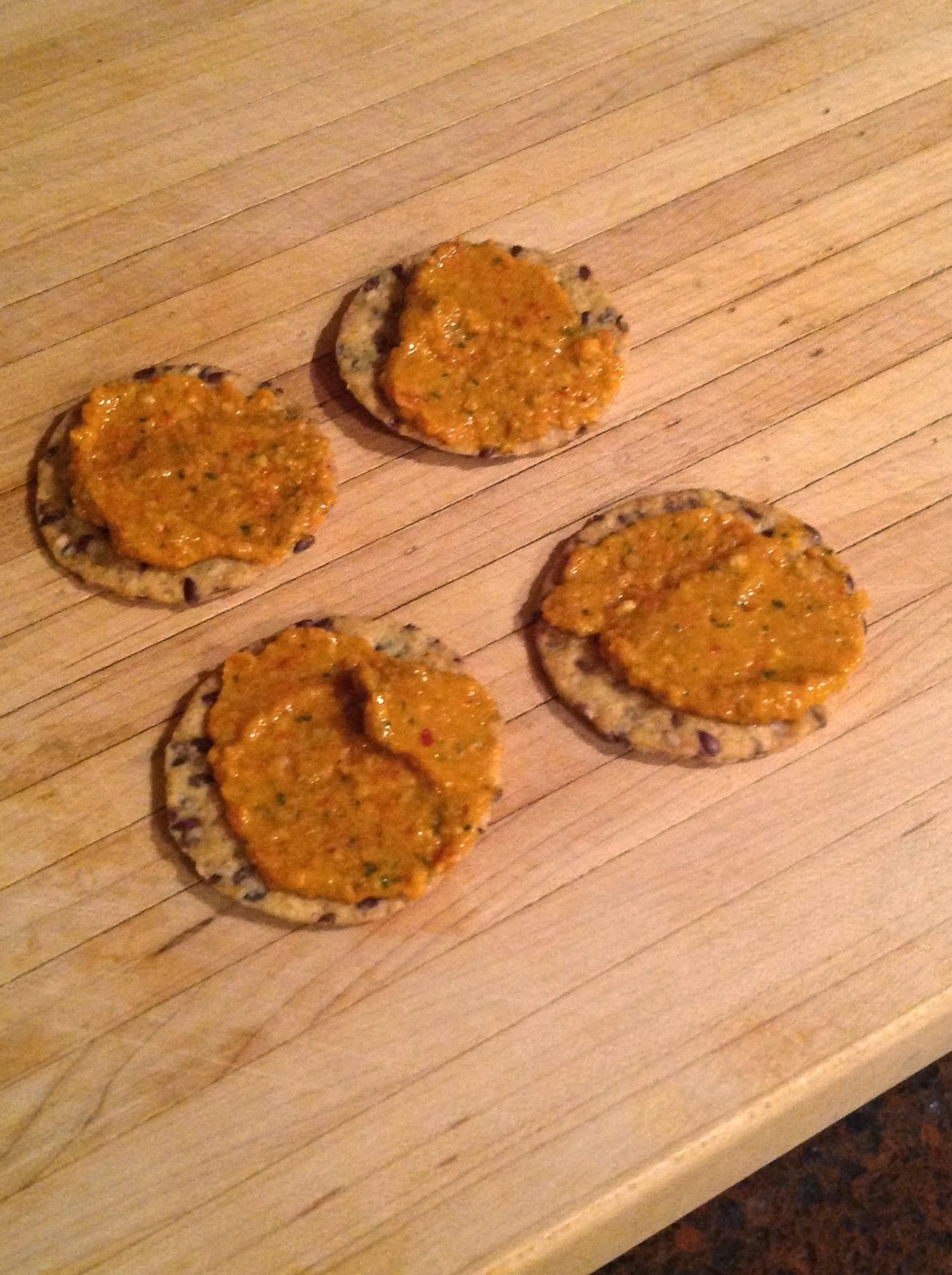
Romesco sauce, a pungent combination of roasted red pepper, garlic, nuts, and chile flakes, is a delicious accompaniment to grilled meats or poultry, fish, or even as a dip for veggies or crackers. I love most anything with roasted red peppers and this sauce is no exception. It's an addictive combination.

The bread, which is acts as a thickener, is usually fried in olive oil. This recipe, from Martha Rose Shulman, skips the frying and uses toasted bread. It makes the recipe quicker. I wouldn't say it makes the sauce light- this is a rich sauce even with toasted bread!

I like Aleppo chiles in this recipe. They are sweet-hot and a little fruity. In Boulder, you can find Aleppo chile flakes at the Savory Spice Shop, my favorite herb and spice purveyors in town. And if you don't have a Savory Spice Shop in your town, they take on-line orders

Romesco Sauce
(makes about 2 cups)

1 large roasted red pepper, cored and skin removed, roughly chopped
¾ pound ripe tomatoes (3 to 4 whole tomatoes)
2 large cloves garlic, peeled
¼ cup whole almonds, toasted
2 oz. crusty white bread, lightly toasted
1-2 teaspoons medium-hot chile flakes, such as Aleppo chiles
1 Tablespoon chopped fresh parsley
1 teaspoon sweet paprika
1 ½ teaspoons salt
½ teaspoon freshly ground pepper
2 Tablespoons sherry vinegar
¼ cup extra virgin olive oil

Place the whole tomatoes on a metal pan and place under the broiler. Broil until it develops some char. Turn over and repeat on the other side. Remove from the oven and let cool slightly. Remove the the skin, and set aside the tomatoes.

With the food processor running, throw in the garlic to mince. Stop the processor and scrape garlic off the sides. Add in the almonds, bread, and chile flakes, and process to a paste. Scrape down the sides again, and add the red pepper, tomatoes, parsley, paprika, salt, and black pepper. Process until smooth. Scrape down sides. With processor running, add the vinegar and then the olive oil in a slow stream. Process until smooth and well-combined. Scrape the sides and taste. Add more salt if needed.

Best if served at room temperature. The garlic flavor builds if it is kept in the refrigerator. Can be refrigerated for up to 5 days. Great as a spread on bread or crackers or as a sauce on fish, chicken, lamb, or vegetables.

From Mediterranean Harvest by Martha Rose Shulman, Rodale, Inc., 2007.

Monday, April 21, 2014

Tamarind Sauce

Tamarind pods. The sticky flesh inside is removed and usually sold in a block.

We ate this sauce on lamb chops but I think it would be wonderful on just about anything grilled: chicken, duck, beef, or shrimp (which is what the original recipe from epicurious.com used it on). It is very intense with the tamarind and the fish sauce. It's not so different from many steak sauces or Worcestershire sauce which are flavored with tamarind and anchovies.

I used tamarind sauce from my local Savory Spice Shop but that's not necessary. If you have tamarind pulp - usually sold in a block  - you can make your own sauce. Look for it in Asian markets, especially Indian ones.

Tamarind Sauce
(makes about ½ cup)

1 Tablespoon tamarind pulp
⅓ cup warm water
1 Tablespoon vegetable oil
1 Tablespoon finely minced cilantro
1 Tablespoon minced garlic (3-4 cloves)
1 Tablespoon Siracha sauce
1 ½ Tablespoon turbinado or dark brown sugar
1 Tablespoon fish sauce

Combine tamarind pulp and water in a small bowl. Let sit for 10 minutes to soften pulp, Using your fingers, rub the pulp in the water to dissolve. Tamarind can have lots of fiber and big seeds so don't be surprised if it doesn't all dissolve. Push through a strainer into another bowl to remove the solids. You should have about 3 Tablespoons tamarind sauce.

Heat oil in a small saucepan until hot but not smoking. Add cilantro and garlic. Cook until fragrant, about 30 seconds. Add the rest of the ingredients and simmer until slightly thickened, about 3 minutes. Serve with grilled meat, chicken, or shrimp. It's intense; one recipe is enough for 4 people.

Photo: pictures of the tamarind-fruit {{cc-by}} Clemens PFEIFFER, 1190 Wien, licensed under Creative Commons from WikiCommons

Tuesday, October 1, 2013

Marcella Hazan: 1924-2013


Marcella Hazan passed away in Florida this week. You can read her obit in the New York Times. She did for Italian food what Julia Child did for French food: she brought the real deal to cooks in the US. Italian food in the US was largely refracted through a Southern Italian lens so everyone thought that Sicilian food was all there was to Italian food before Marcella came along. Like so many cuisines, Italian cuisine is regional, varying greatly from the lagoons of Venice to the rich valleys of Emilia-Romagna to the rocky slopes of Sardinia.

I have both The Classic Italian Cook Book and More Classic Italian Cooking. The recipes are simple, yet detailed, and delicious. Mrs. Hazan lived in Emilia-Romagna as a child but her books are a trip through all the regions of Italy. She has a recipe for Meat Sauce, Bolognese Style, from her home region, as well as five recipes for Polenta which she says was the "staff of life" in much of Lombardy and all of Venetia (the northeast corner of Italy), and Hothouse Lamb, Roman Style from Rome, naturally. Many Italian regional books have followed - I have a lot of them - but Mrs. Hazan was the first. And she'll always be the greatest for me.

Later this week, really cold weather is moving in. It's likely that Boulder will experience the first hard frost of the year. (We already had a light one last Friday night.) That means I must pick all the basil and make pesto. That's about as Italian as you can get, isn't it? Today, everyone knows pesto and it is well-loved in the US. But, back in 1973 when the first printing of The Classic Italian Cook Book came out, very few Americans had ever eaten or heard of pesto. It's from a rather obscure region of Italy: Liguria. Well, not obscure anymore. The Cinque Terre, that string of five marvelous towns clinging to the steep hillsides, is in Liguria. There are lots of riffs on pesto these days: different herbs, different nuts, different seasonings. Marcella Hazan's recipe is a departure too, as she explains in the introduction: "The old traditional recipes do not mention pine nuts or butter. But modern pesto invariably includes them, and so does this recipe." I ate pesto in a traditional restaurant in the Cinque Terre. It did include pine nuts, but definitely not butter. And no black pepper - they were particularly adamant about no black pepper. Mrs. Hazan does not use black pepper either.

The recipe is written just as it is in the book so you can see how thorough she was describing how to make something as simple as pesto.

My notes on the recipe: I don't need that much salt in my pesto. Half a teaspoon is enough for me. Your mileage may vary.

Blender Pesto
(Enough for about 6 servings of pasta)

2 cups fresh basil leaves (see note below)
½ cup olive oil
2 Tablespoons pine nuts
2 cloves garlic, lightly crushed with a heavy knife handle and peeled
1 teaspoon salt
½ cup freshly grated Parmesan cheese
2 Tablespoons fresh grated Romano pecorino  cheese
3 Tablespoons butter, softened to room temperature

Put the basil, olive oil, pine nuts, garlic cloves, and salt in the blender and mix at high speed. Stop from time to time and scrape the ingredients down toward the bottom of the blender cup with a rubber spatula.

When the ingredients are evenly blended, pour into a bowl and beat in the two grated cheeses by hand. (This is not much work, and it results in more interesting texture and better flavor than you get when you mix the in the cheese in the blender.) When the cheese is evenly incorporated into the other ingredients, beat in the softened butter.

Before spooning the pesto over pasta, add it to a tablespoons of the hot water in which the pasta boiled.

Note: The quantity of basil in most recipes is given in terms of whole leaves. American basil, however, varies greatly in leaf sizes. There are small, medium, and very large leaves, and they all pack differently in the measuring cup. For the sake of accurate measurement, I suggest that you tear all but the tiniest leaves into two of more small pieces. Be gentle, so as not to crush the basil. This would discolor it and waste the first, fresh droplets of juice.

Friday, October 26, 2012

Ginger Apple Sauce


We love apples and this year has been particularly good for the local apple crop. A number of our friends have gifted us with apples from their trees. They are usually pretty tart, but still quite edible. They are perfect for making applesauce.

We love ginger too so this applesauce is a nice change. No cinnamon here. Just apples, a little sugar, lemon juice, and grated ginger. My husband declared this the best applesauce ever.

I like to mix apple varieties when making applesauce. MacIntosh apples cook down quickly which makes them favored for applesauce. I like to mix in Jonathan's because of their great flavor but they take longer to cook. If you use different varieties than this mix, you'll have to adjust the cooking time depending on how well the apples are breaking down.

Gingered Applesauce
(makes 4 cups)

4 Tablespoons fresh lemon juice
3 pounds apples (I like to use ½ MacIntosh and ½ Jonathan)
⅓ cup sugar + a bit more, depending on the tartness of the apples
⅔ cup water
1 Tablespoon grated fresh ginger

Place the lemon juice into a medium saucepan. Peel, core, and cut the apples into eighths, tossing them in the lemon juice as you go to keep them from turning brown.

Add sugar, water, and ginger. Bring to a boil. Reduce heat to medium-low, cover, and cook for anywhere from 10 minutes to 30 minutes, until the apples are quite tender. Remove from heat and mash with a fork, living some chunks. Taste, and if the applesauce is too tart, add a bit more sugar.

Followers