
I don't eat a lot of persimmons. But, sometimes it's fun to step away from the parade of wintertime citrus, too-long-in-storage apples, and grapes from warmer climes. For the persimmon novice, you need to know there are two varieties and they are very different. One, the Fuyu, can be eaten while still slightly crunchy. They taste a bit like apples to me. You can also eat them when they are fully ripe. They will be sweeter and the texture will be slightly squishy.
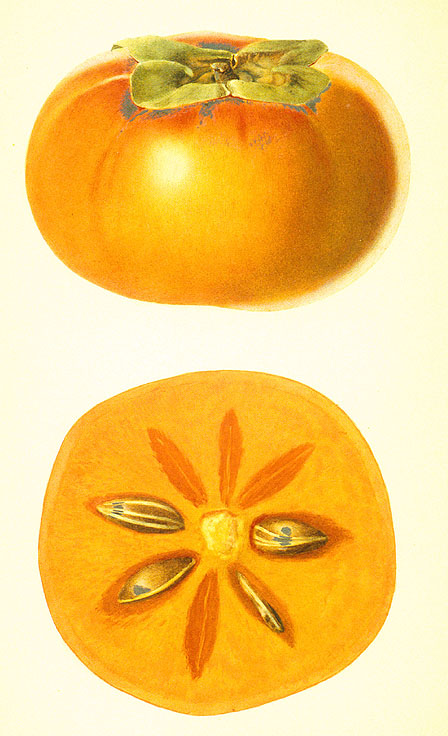 |
| Fuyu Persimmon, small and squat and can be eaten while still crunchy. Illustration from USDA |
 |
| Hachiya Persimmon, taller and can only be eaten when very soft. Illustration from USDA |
Rather then eat them out of hand, I used them to make persimmon bread, like banana bread. They add a nice flavor and plenty of sweetness. They are very sweet when ripe so there isn't a lot of sugar in this quick bread. This is a great snack or tea bread.
Persimmon Bread
(serves 12)
1 cup unbleached all purpose flour
1 cup whole wheat pastry flour
¾ teaspoon baking powder (1 teaspoon at sea level)
1 ½ teaspoon baking soda (same at sea level)
½ teaspoon salt
1 teaspoon ground cinnamon
¼ teaspoon ground nutmeg
2-3 Hachiya persimmons or 4-5 Fuyu, very ripe
1 stick unsalted butter, at room temperature
½ cup sugar
1 large egg, at room temperature
¼ cup sour cream
2 teaspoons almond extract
1 cup dried apricots, chopped
½ cup slivered almonds, toasted (see Note)
Adjust a rack to the middle of the oven . Preheat oven to 350°F. Lightly butter a 8"x4"x2½" loaf pan. Set aside.
Sift the flours, baking powder, baking soda, salt, cinnamon, and nutmeg into a medium bowl.
Cut each persimmon across the equator and gently scoop out the flesh: run the spoon under the skin to loosen the flesh, then spoon out the flesh away from the center part that is fibrous and contains the seeds. Place in a small bowl and mash the pulp with a fork. Measure out 1 cup of persimmon pulp. Any leftovers can be eaten with a spoon, frozen for another bread, or added to a smoothie.
Cream together the butter and the sugar until light and fluffy. Add the egg, and beat to combine well. Add the persimmon pulp, sour cream, and almond extract. Beat to combine. With the mixer on slow speed, slowly add the dry mixture, scrapping down the sides so everything is combined. Add in the dried apricots and toasted almonds and mix to distribute evenly. Scrape the batter into the loaf pan, set on a rimmed cookie sheet (in case it overflows; it shouldn't), and bake for 1 hour - 1 hour 10 minutes. The bread is done when a skewer comes out without any wet batter.
Let cool on a rack for 20 minutes. Remove from loaf pan and cool to room temperature. The bread is hard to slice when warm so be patient!
Note: to toast almonds, place nuts on a sheet pan in a 300°F oven for 8 minutes. Set a timer - it's easy to burn nuts. I speak from experience.
Adapted from Nicole Routheir's Fruit Cookbook by Nicole Routhier, Workman Publishing, 1996.

