New Location

You can find all the old content and new stuff too at worldplatterblog.wordpress.com
Showing posts with label lemon. Show all posts

Wednesday, April 20, 2016

Food Photos: The Bane of My Existence


Why do I use photos that clearly aren't a photo of the dish I'm writing about? Because I hate having to take photos of my food! Sometimes, it's my dinner. If I need to style the dish, I'm eating a cold dinner. No thank you! Sometimes, my dinner isn't particularly photogenic. As a blog reader, I'm annoyed by articles that have endless photos of the food from every angle along with many photos of the production. Overkill, I say. I also have no patience for scrolling over a bunch of photos to get to the recipe I am looking for.

But, a photo is important for catching a reader's eye in the overwhelming noise that is the internet. That's why I include interesting photos of food that I have found in Wikipedia Commons in my posts, when I don't like/can't be bothered to snap a gauzy, perfectly lit photo of my dinner (oh, wait, I never do that). Live with it. I cook and I write about food which is my passion. Photography definitely isn't my passion. I leave that to people who are way better at it than I am!

Now, I discover that the photos blow up my list of most popular posts. Ugh! As I said, photos make me crazy. [It's a bug in the widget from Blogger so I hope the thumbnails will reappear at some point.]

The photo above is mine. It's not all that pretty but that cauliflower sure tastes good! It's seasoned with tahini, lemon juice, and Aleppo pepper. Aleppo red pepper is slightly spicy - not nearly as hot as crushed Italian red pepper - and has a lovely fruity flavor. I think it's far more useful in the kitchen than crushed red pepper because it's more subtle. Find some. You won't be sorry. It's great on eggs, hummus, chicken, and right here in this cauliflower recipe.

Roasted Cauliflower with Tahini and Lemon
(serves 4-6)

non-stick cooking spray
1 large head of cauliflower
salt
¼ cup tahini
juice of 1 lemon
¼ to 1 teaspoon Aleppo red pepper

Preheat oven to 400°F. Spray a large rimmed cookie sheet generously with non-stick cooking spray.

Trim off leaves and cut off the tough bottom of the stem on the head of cauliflower. Most of the stalk is edible so don't try to cut out all of it. It will cook up tender. Slice the cauliflower about ½" thick. The slices won't hold together; doesn't matter. Put the cauliflower, in a single layer, on the greased cookie sheet. Spray with cooking spray and sprinkle with salt. Roast the cauliflower in the hot oven for 30 minutes or until tender.

While the cauliflower is roasting, combine the tahini, lemon juice, and Aleppo pepper in a small bowl. Set aside.

When the cauliflower is done, remove from the oven and increase the heat to broil. Spread the tahini sauce evenly over the cauliflower. Return the cauliflower to the oven and broil until the sauce browns up. Serve hot.

Tuesday, April 5, 2016

Cream of Asparagus Soup with Lemon


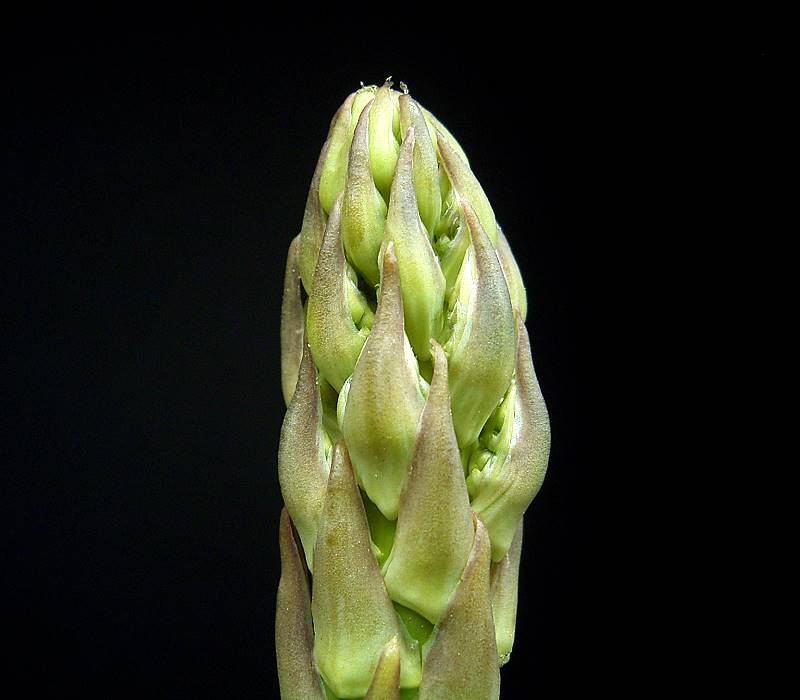
Springtime means asparagus. We won't have any local asparagus here in Colorado for a while yet. But, it's turning up at bargain prices in the supermarket (some weeks as low as $1.50/pound). We love asparagus roasted, steamed, and grilled. Here it is featured in a fresh-tasting soup. It gets some thickness from the potato, which means you don't need to use a lot of cream. The lemon keeps it bright and light.

I like to buy thick spears of asparagus and for this recipe, that is the best choice. You'll be peeling them and it's pretty dang hard to peel a skinny stalk of asparagus! If you don't peel the asparagus, you'll have a bunch of stringy fibers that don't purée well. If you have a really good blender, like a VitaMix (I don't, but I used them when I worked in restaurants), no worries. It can handle the peels. My blender isn't that effective, so I make sure to peel the stalks.

Cream of Asparagus Soup with Lemon
(serves 8)

1 ½ pounds asparagus
5 cups low-sodium chicken stock
4 medium shallots, peeled and minced
1 medium baking potato, peeled and cut into ½" dice
2 lemons
¾ cup heavy cream
salt and black pepper

Trim off about ½" of the bottom of the asparagus stalks. Peel the lower ⅔'s of each stalk. Cut off the tips and set aside. Cut the rest of the stalks into 1" lengths. Set aside in a bowl.

Zest the lemons and put the zest in the bowl with the asparagus stalk pieces. Add the shallots and the potato. Juice 1 lemon and set aside the juice.

In a medium soup pot, heat up the stock. Cook the asparagus tips in the stock for 2-3 minutes, until tender. Remove with a slotted spoon and set aside.

Add asparagus stalks, shallots, zest, and potato to the stock. Cook for 30 minutes until the potato and asparagus are very tender.

Blend the contents of the pot until smooth. You can use an immersion blender right in the soup pot or you can transfer the soup, in batches, to a blender. Return the puréed soup to the pot. Add the cream and reheat until hot but not boiling. Stir in the lemon juice, salt (how much will depend on your palate and the type of stock you use), and ¼ teaspoon black pepper.

Serve with the reserved asparagus tips as garnish.

Adapted from 300 Sensational Soups by Carla Snyder & Meredith Deeds, Robert Rose, Inc., 2008.

Photo Credit: By Frank Vincentz (Own work) [GFDL (http://www.gnu.org/copyleft/fdl.html) or CC-BY-SA-3.0 (http://creativecommons.org/licenses/by-sa/3.0/)], via Wikimedia Commons

Friday, January 15, 2016

How Salty is the Ocean?


This morning, I heard a chef say "Make your pasta water as salty as the ocean." I've heard many TV chefs say this. To me, a resident of a landlocked state, this is useless advice. I don't spend much time at the beach and my memory of the saltiness of any ocean water is pretty dim. Let's just say this is a pretty imprecise way to describe how salty your pasta water should be. I will say that once you do it more precisely (which is below), you can taste it and then you will know what ocean salty tastes like.

How salty is the ocean? There is 3.5 g of salt per liter of ocean water. This is an approximation since not all parts of the oceans have the same salinity. But, for our purposes, 3.5 g/l is good enough.

But, most Americans don't think is grams or liters. After converting, it comes pretty close to ½ teaspoon of salt for each quart (4 cups) of water. My pasta pot holds 8 quarts, so I should add 4 teaspoons of salt, a heaping Tablespoon. Use a smaller pot and less water, add less.

The next time you cook pasta, measure the water and salt. Then taste the water. Do it a few times and you'll know how salty the ocean tastes! Or do what I do: put the same amount of water each time and put the same amount of salt in your palm each time. No need to taste the water.

While we are talking pasta and oceans, how about a recipe for pasta with clam sauce? This has been a favorite recipe in my house for a long time. It came from a collection of Junior League recipes from the Eastern US. This is a quick recipe. The sauce comes together while the pasta is cooking.

Linguini with Lemon-Clam Sauce
(serves 4)

2 6½ oz. cans chopped clams in clam juice
2 shallots, minced
3 cloves garlic, minced
3 Tablespoons olive oil
1 teaspoon dried oregano, crushed
¼ teaspoon pepper
2 Tablespoons chopped fresh parsley, about 6 sprigs
1 lemon
salt to taste
1 pound of linguine
Parmesan cheese for garnish (optional)

Drain clam juice from canned clams and reserve both juice and clams, separately. Zest lemon - you need about 1 teaspoon of zest (a little more or less is fine). Then juice the lemon. You need 2 Tablespoons juice. Bring a pot of salted water to a boil and drop in the linguine.

Heat olive oil in a large skillet over medium-low heat. Add shallots and garlic. Cook until translucent. Add clam juice, oregano, and pepper. Raise heat to high and bring to a boil. Cook until liquid is reduced to a few tablespoons. Lower heat to medium. Add clams, parsley, lemon juice, and lemon zest. Cook at a simmer to heat up clams. When the pasta is cooked to al dente (don't over cook as it will continue to cook in the sauce), scoop out a few tablespoons of pasta cooking water and add to the skillet. This helps to thicken the sauce, from the starch in the water. Drain the pasta and add to the skillet. Toss to coat with the sauce. Taste for salt. The clams, clam juice, and pasta water are salty so you may need nothing. Serve hot in a bowl with bread to sop up sauce.

The cheese is absolutely optional. In Italy, they consider Parmesan cheese an abomination on a seafood pasta. But, you do what you want because you don't need to live by Italian rules. This is an American recipe!

Recipe adapted from The Eastern Junior League Cookbook edited by Ann Seranne, David McKay Company, Inc. 1980.

Photo credit: By Daniel Schwen (Own work) [CC BY-SA 2.5 (http://creativecommons.org/licenses/by-sa/2.5)], via Wikimedia Commons

Friday, January 2, 2015

Lemony Shrimp Risotto


Happy 2015, everyone! Here was the first dinner of the new year in my house, a lemony shrimp risotto. Huge shrimp! You don't need to use such gigantic ones; that's just what I had in the freezer. The hardest part of this recipe is finding the shrimp or fish stock. You can make your own shrimp stock from the shells. It's wonderful stuff. Or, you can use Better Than Bouillon Fish or Lobster Base. This is a very good product. All their bases are quite good for not-homemade stock.

This recipe is adapted from one by Jamie Oliver. That one is sort of a disaster. I think someone edited it in a half-hearted way and it ended up a mess. I'm not going to even tell you where it is because I don't recommend you try following it. Yes, it's that jumbled up. And it's in metric to boot.

The original recipe called for the juice of a whole lemon. My family unit said it was too tart. The zest isn't tart so use all the zest but only half the juice.

Peppadews are sweet and very mildly spicy peppers.  You can find them in jars or at your supermarket olive bar. Most of the olive bars in Boulder carry them. They are very tasty!

Lemony Shrimp Risotto
(serves 4)

7 cups shrimp or fish stock
2 Tablespoons dried minced onion
1 teaspoon kosher salt, if using unsalted stock
2 Tablespoons olive oil
1 ⅔ cups Arborio or similar short-grain rice
6 oz. white or rosé wine
1 ½ cups frozen peas
about 1 pound peeled and deveined medium to large shrimp
1 lemon
4 Peppadew peppers, diced or a pinch of crushed red chile flakes
black pepper

Zest the lemon and set aside the zest. Juice half the lemon and set aside the juice. In a medium saucepan, mix together the stock, dried onion and salt (if using). Heat to a simmer and keep it there. Season the shrimp with salt and pepper and set aside.

In a large saucepan, heat up the olive oil on medium-high. Add the rice and cook it until the grains of rice chance from translucent to opaque. They turn a milky white. Add the wine and cook until wine has evaporated/been absorbed. Reduce the heat to medium. Add ¾ cup of hot stock and stir until all the stock is absorbed by the rice. You don't need to stir it constantly, but you need to stir it regularly, every few minutes. When the liquid has been absorbed, add some more stock and stir once more. Keep this up until the rice is very nearly done. At 5400 ft., that takes nearly 30 minutes, longer than most recipes say to cook it. I recommend you try the rice so you know how close you are to done. If it's crunchy, not done. If you say "hmm, very close but not quite there," it's time to add the shrimp and peas. Stir to combine. Cover and cook for about 5 minutes until the peas are hot and the shrimp is pink and cooked. You don't want to cook the shrimp any longer than necessary because it will get tough. So, there is some timing involved here - you want the risotto just done when the shrimp is just done.

Just before serving, add the lemon zest, lemon juice, Peppadews, and a light sprinkle of black pepper. Taste for salt and season with more if needed. Serve in hot bowls with some shrimp arranged on top, because you want to show off the shrimp, especially if they are as big as the ones in my risotto!


Wednesday, January 30, 2013

Lamb Chops with Gyro Marinade

This recipe was inspired by my daughter who loves gyros. Gyros are a combination of ground meats, beef and lamb usually, with some nice herbs mixed in. I think the secret ingredients are lemon and a generous amount of garlic. I found a recipe in The New Look of American Lamb from the American Lamb Council (thanks Kasja!) for lamb gyros and ran with that. They turned out mighty tasty!

Lamb Chops with Gyro Marinade
(serves 4)

3 cloves garlic, minced or pressed
3 Tablespoons extra-virgin olive oil
1 ½ teaspoons dried lemon peel or the zest of 1 fresh lemon
¾ teaspoon dried basil
¾ teaspoon dried marjoram
1 ½ teaspoon dried rosemary
2 Tablespoons chopped fresh parsley
8 lamb rib chops or 4 lamb shoulder chops
salt and black pepper

Mix together garlic, olive oil, and lemon zest in a non-reactive pan that will hold all the lamb chops in one layer. Crumble up the dried herbs in your palm and add to the garlic mixture. Add the parsley and mix to combine. Put the chops in the dish and rub the herb mixture all over the lamb. Cover and refrigerate for up to 8 hours.

Season lamb chops with salt and black pepper. Broil or grill to desired doneness. We like our lamb medium-rare but you do what you got to do to keep your diners happy.

Followers